
APPKADIA / NOTE
Artificial intelligence in industry
Published10 September 2024
AuthorAppkadia
Reading time10 min
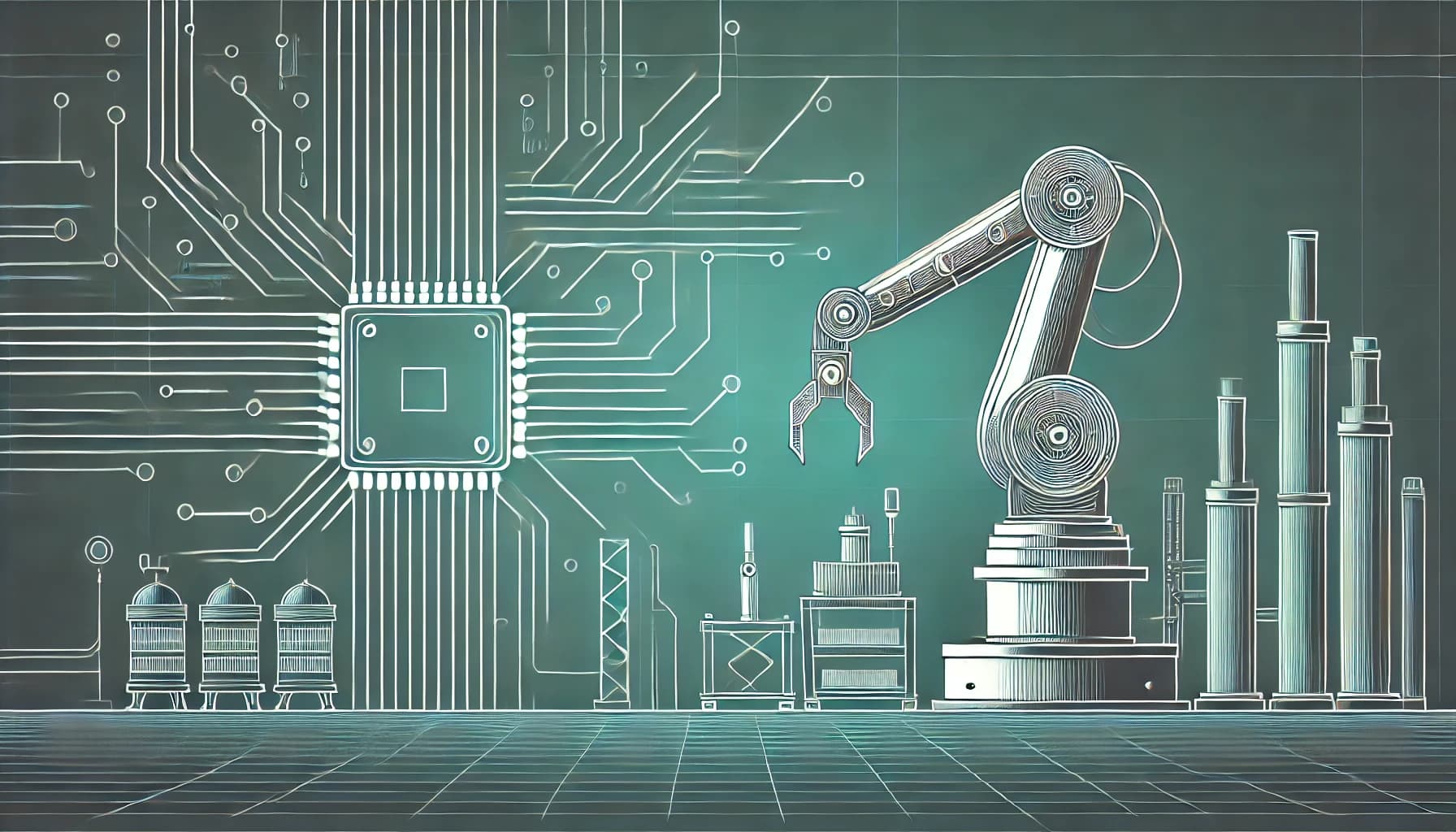
Artificial intelligence in industry is transforming how goods and services are produced. From healthcare to finance, artificial intelligence has entered many sectors, and industry is no exception.
Until recently, when we thought about factories, the first things that came to mind were people working on production lines, heavy machinery and rather old-fashioned processes. But artificial intelligence in industry has arrived to turn all of that on its head. Today, AI is changing the rules in factories, making processes much faster, more accurate and, above all, more efficient. The result? Smarter, more agile factories that are ready to face the challenges of the modern market.
How does it do that? AI analyses vast quantities of data — more than we could imagine — and makes decisions based on it. That means fewer errors, higher quality and lower costs. Sounds good, doesn’t it? Get ready, because this is only the beginning.
1. Automation and efficiency
AI-powered robotics
AI robots are far more than mechanical arms that assemble products. These intelligent systems can adapt to production changes in real time. If a component is defective, for example, the robots not only reject it but also adjust their movements to prevent the error from happening again. The result is fewer defects and faster production. This applies equally to assembling a car and packaging products, all with millimetre precision that people could not match.
Smart factories
A smart factory is like a giant brain controlling everything that happens inside it. How? Sensors collect data from every corner of the plant. AI takes those data, analyses them and optimises every stage of production. If one machine is working too hard, AI redistributes the load to other machines. Is somebody about to run out of components in the warehouse? AI knows before it happens and adjusts the supply chain. With artificial intelligence in industry, everything is connected and works in perfect synchronisation.
Predictive maintenance
The magic of predictive maintenance lies in preventing disasters before they happen. AI constantly monitors machinery for vibration, temperature and wear. If it detects anything unusual, it issues an alert so the maintenance team can act before the machine stops or, worse, breaks down. Factories avoid costly downtime while extending the useful life of their equipment. What factory would not want to stay ahead of problems?
2. Quality control and defect detection
AI for quality assurance
Imagine having an eye that never tires and can detect even the tiniest defect. That is what artificial intelligence in industry brings to quality control. Instead of relying on human inspections — which, let’s be honest, can miss details — AI uses cameras and advanced algorithms to scan every product passing along the production line. Whether it is a small crack in a part or a colour that is very slightly off, AI detects it and flags the error immediately. This not only delivers higher-quality products, but also reduces customer rejections and returns.
Computer vision
Computer vision is essentially what enables machines to ‘see’ what is happening on the production line. And we do not mean simply seeing: it analyses every detail with laser-like precision. The technology identifies visible defects and also learns over time. The more it inspects, the better it becomes at detecting patterns that may indicate problems. In automotive component production, for example, AI can identify microscopic scratches that the human eye could not see unaided.
Saving time and reducing waste
Best of all, AI does not need a break. It operates around the clock, inspecting thousands of products without losing speed or accuracy. The result is much more efficient quality control and a significant reduction in defective products being discarded. In short: less waste, lower costs and happier customers receiving products that exceed their expectations.
3. Supply-chain optimisation
Demand forecasting
Imagine predicting what your customers will need before they know it themselves. That is exactly what AI is doing with demand forecasting. By analysing historical data, market trends and even the weather — yes, weather affects sales — artificial intelligence in industry can forecast which products will sell more and when. This helps factories adjust output so that they have neither excess inventory nor shortages. Everything is made to measure, like a well-cut suit.
Intelligent inventory management
It is not only about predicting demand. AI also optimises inventory, ensuring that the necessary parts and materials are always available without going too far. Algorithms monitor material use, stock levels and consumption trends in real time. If a component is likely to run out soon, AI can automatically place orders with suppliers or redistribute resources across the supply chain. It all serves one objective: keeping production moving without bottlenecks.
Logistics optimisation
Then there is logistics, where AI really shines. AI-based systems can plan the most efficient delivery routes, reduce transport costs and minimise waiting times. An unexpected traffic jam? AI can adjust routes in real time. A delay at a port? It is already assessing alternatives so the goods arrive on time. This saves money and ensures that products reach customers when expected — or even earlier.
4. Personalisation and design
AI in product design
You want a product that meets your exact needs, as though it had been designed just for you. Thanks to AI, that is now possible. Artificial-intelligence-powered design tools can create highly personalised products at a speed that was previously unimaginable. AI can analyse your preferences, how you intend to use the product and thousands of other data points to generate a bespoke design in minutes. Better still, the process becomes more accurate every time it is repeated.
Mass customisation
This is where things become even more interesting: mass customisation. It sounds contradictory, doesn’t it — making personalised products at scale? AI makes it entirely possible. Imagine a factory producing hundreds of pairs of trainers each day, with every pair designed specifically for one customer’s feet. AI can adjust the design, materials and even the production process so that each product is unique, without sending costs soaring. Rather than manufacturing identical products, factories can now make products for you and to your measurements without sacrificing efficiency or money.
Shorter design cycles
AI systems can also test different versions of a design in seconds. Remember the endless prototypes that used to be made before launching a product? AI can now generate, test and optimise those prototypes digitally. This shortens the development cycle and allows companies to launch products much faster and with less risk. The advantage? Businesses respond more quickly to market trends and you receive improved products in record time.
5. Transforming the workforce
Automating repetitive tasks
Artificial intelligence in industry is automating many of the most repetitive and physical tasks. Processes such as assembly, packaging and quality control, which once depended on human intervention, are now carried out by robots and automated systems. This evolution is not only about speed, but also precision and efficiency, and it is transforming the role of factory workers.
New roles and reskilling
This change in working practices does not mean that workers are simply being replaced; their roles are evolving. Instead of carrying out repetitive manual tasks, they can take on more strategic and technical positions. That has created strong demand for reskilling and new capabilities. Workers are moving from operating traditional machinery to managing and supervising automated systems, and many companies are investing in training programmes to support their staff through this transition.
A machine operator who once worked on a production line might, for example, learn to program and supervise the robots that now perform that work. A maintenance technician might use AI tools to forecast failures and keep equipment in optimum condition before problems arise. These are just some of the new roles being created by artificial intelligence in industry.
Collaboration between people and machines
This transformation is also bringing people and machines into closer collaboration. While AI performs more routine tasks, workers focus on activities that require creativity, problem-solving and decision-making. Smart factories need not only efficient machines, but also people who understand how to make the most of these technologies, adjust processes and optimise overall performance.
The future of industrial work is not only about technology; it is about how workers and machines can collaborate to achieve better, more efficient results. Automation is crucial, but people remain essential to innovation and to guiding change.
6. Sustainability and waste reduction
AI for energy efficiency
Did you know that a factory can consume enormous amounts of energy simply because it has not been properly optimised? This is where AI makes a difference. By analysing energy use in real time, AI can identify which machines are using more energy than necessary and adjust them immediately. It can also forecast periods of peak consumption and redistribute resources to balance energy use. That means both a sizeable saving on the bill and a positive impact on the environment.
Reducing waste
What about all the material wasted in factories? AI is helping to reduce that significantly too. By analysing production processes, it can detect inefficiencies that create material waste. If a production line is using more raw material than necessary, for example, AI adjusts the parameters to minimise the excess. The result? Less material lost, more products made with fewer resources and, of course, less environmental impact.
Sustainable production
AI does more than reduce waste and optimise energy use; it is also advancing sustainable production practices. AI-guided smart factories can select renewable energy sources at the best times, adjust processes to minimise CO2 emissions and reuse materials wherever possible. The goal is to create high-quality products with the smallest possible environmental impact. Being efficient and considerate of the planet is not merely a competitive advantage — it is a responsibility.
7. The future of ARTIFICIAL INTELLIGENCE IN INDUSTRY
Autonomous factories
Can you imagine a factory running almost by itself, with minimal human intervention? That is no longer a futuristic dream. Thanks to AI, the idea of an autonomous factory is drawing ever closer. In these factories, AI systems do more than execute processes: they also make decisions in real time. From adjusting production speed to reordering missing components, AI keeps everything under control. Best of all, it happens around the clock without interruption, taking efficiency to an entirely new level.
Integration with IoT, 5G and blockchain
AI is not alone in this revolution. Emerging technologies such as the Internet of Things (IoT), 5G and blockchain are joining in to make factories even smarter. IoT enables machines and devices to connect and ‘talk’ to one another, sharing data in real time. And 5G? It is the technology that will make all of that communication ultra-fast, eliminating delays and optimising processes even further. Blockchain, meanwhile, ensures that the data are handled securely, tracing every step in the supply chain without errors or tampering.
Continuous innovation
The future of AI in manufacturing is not just about preserving what has already been achieved. We are at a point where innovation is constant. New applications and improvements emerge every day, from machines that teach themselves to become more efficient to systems that can forecast not only failures but also opportunities for improvement. If factories are already faster, more efficient and more sustainable thanks to AI, imagine what may be possible in the years ahead.
Conclusion
Artificial intelligence is no longer merely a futuristic concept: it has become the engine revolutionising manufacturing. From robots that do the heavy lifting to factories that think for themselves, AI is transforming every corner of the production process. Best of all, it is not only about becoming faster or more efficient, but doing so more intelligently, sustainably and personally.
The future of manufacturing is bright, and AI sits at the centre of that evolution. Tomorrow’s factories will be autonomous, interconnected spaces capable, above all, of adapting to a constantly changing world. Although machines and algorithms are taking a leading role, there will always be space for human creativity and vision.
So the next time you see a flawless product or receive something earlier than expected, remember: there is probably an AI brain behind it, working tirelessly to keep everything running like a well-oiled machine. The future is already here.