
APPKADIA / NOTE
A complete guide to APIs and web services: driving technological innovation
Published1 December 2023
AuthorAppkadia
Reading time4 min

Today we are looking at a subject that is essential in technology but often goes unnoticed: APIs and web services. These concepts are the foundations that allow the applications and systems we use every day to work together efficiently. In this guide, we explain in straightforward terms what APIs and web services are, how they work and why they are so important to the technology around us. If you want to understand the digital applications and services that are part of your life, you are in the right place.
1. What are APIs and web services?
APIs (application programming interfaces): An API is a set of rules and specifications that programmers can follow to access and use the functions or data of another service or application. It acts as a bridge between different software programs, allowing them to interact without either one needing to know how the other system has been implemented.
Web services: Web services are a collection of protocols and standards used to exchange data between applications or systems. Unlike APIs, which may be internal to a particular piece of software, web services are designed for communication over a network, usually using HTTP.
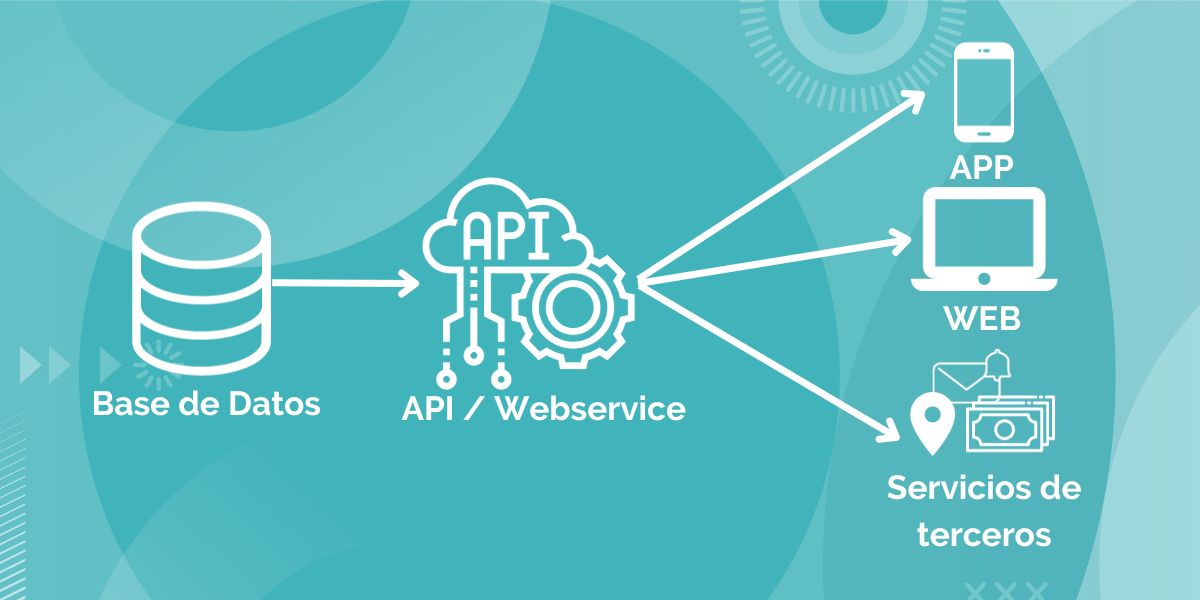
2. How does an API work?
An API works like a contract between two software programs: one offers services and the other uses them. They communicate through requests and responses. Imagine that you have a weather-forecast app on your phone. It needs current weather data to work. Rather than creating its own weather database, the app uses an API from a meteorological service. When you open the app, it connects to the weather service through the API, obtains the data it needs and presents them on your screen. The API is the intermediary that makes all of this possible.
Web services operate in a similar way, but generally use web protocols for communication, including SOAP, REST and XML-RPC.
3. Types and categories
APIs take various forms, including web APIs, programming libraries and system APIs. Web APIs are the most common in the Internet age. They allow web applications to communicate with servers and external services to access data and functionality. Examples include social-media APIs that allow content sharing and online-payment APIs that manage secure transactions.
There are several types of API, including:
- Web APIs: Enable communication between web applications.
- Operating-system APIs: Provide access to operating-system functions.
- Software-library APIs: Offer specific functions, such as graphics libraries for games.
Web services may be classified as:
- SOAP (Simple Object Access Protocol): Highly standardised and uses XML for communication.
- REST (Representational State Transfer): More flexible and uses URLs and HTTP.
4. Practical applications
APIs are used in many everyday applications. When you share a photo from your gallery app on a social network, for example, you are using an API.
Web services are fundamental to e-commerce, where different services — such as payments, inventory and logistics — need to communicate efficiently.
Web services are a specific category of API. The technology allows different applications and systems to communicate over the web using standards such as HTTP and XML. Web services perform specific tasks or share data between applications and systems in different geographical locations.
5. Benefits and importance
APIs and web services make software development more scalable and flexible. They facilitate the integration of new components or services, improve the functionality of existing applications and encourage innovation.
6. Technical considerations
Security, request limits and error handling must all be managed carefully in APIs and web services. Developers need to ensure that data remain secure and that services are reliable and scalable.
7. The future and emerging trends
With the rise of the Internet of Things (IoT), artificial intelligence and Big Data, APIs and web services will play an even more important role in connecting devices and systems. The movement towards lighter and more efficient APIs, such as GraphQL APIs, and the use of web services in cloud computing both point towards the future of technology.
Conclusion
In short, APIs and web services are crucial components of today’s digital world, enabling integrated and efficient software ecosystems to be created. Their importance will only grow as the digital age advances, creating new opportunities for innovation and technological transformation.
PRACTICAL GUIDE / API + WEB SERVICE
The difference between an API and a web service.
An API defines how two pieces of software exchange functions or data. A web service is an API accessed over a network using web technologies. All web services are therefore APIs, but not every API is a web service.
| Criterion | API | Web service |
|---|---|---|
| What it is | A contract for using functions or data | A service accessed through web technologies |
| Where it runs | Inside an application, device or network | Usually between systems connected over HTTP |
| Common styles | REST, GraphQL, libraries or system APIs | REST, SOAP and message-based services |
| Typical use | Applications, mobile, hardware and integrations | Exchanging information between systems |
What are public web services?
They are documented services exposed by an organisation so third parties can query data or perform operations—for example geographic information, weather, transport, payments or catalogues. Authentication, usage limits, availability, privacy and provider terms must be reviewed before integration.
REST, SOAP or webhook?
REST often fits lightweight web APIs; SOAP remains relevant when strict enterprise contracts and standards apply; a webhook lets one system notify another when an event occurs. The right choice depends on the process, risk and existing systems.