
APPKADIA / NOTE
Python explained: the features and applications of this powerful programming language
Published29 June 2023
AuthorAppkadia
Reading time8 min
In the vast world of programming, Python has earned a special place among developers. With its simplicity, readability and versatility, Python has conquered a wide range of applications, from the web to data science and artificial intelligence. But where did Python come from? How did it all begin?
The origins of Python
Python begins: a Christmas project
Python was born in December 1989 through the initiative of Guido van Rossum, a Dutch programmer working at the Centrum Wiskunde & Informatica (CWI) in Amsterdam. During the Christmas holidays, Guido embarked on a personal project to create a programming language as powerful as C, but much easier to read and use.
The idea drew on his experience with the ABC programming language, which had also been developed at CWI. Although ABC was intended to be easy for beginners, it had failed to gain much traction. Guido wanted to take the best parts of ABC and create a new language that would be more attractive to developers.
A name with a sense of humour
Contrary to what you might think, the name ‘Python’ has nothing to do with snakes. It actually comes from ‘Monty Python’s Flying Circus’, the popular British television programme. Guido was a great fan of the show and wanted a name that was short, distinctive and a little mysterious. So he chose Python.
Python’s growth and development
The first public release, Python 0.9.0, arrived in February 1991. It already included some of the features that define Python today, such as indentation to define blocks of code and the ability to handle high-level data types including lists and dictionaries.
Python continued to evolve and add new features over the years. Python 1.0, released in 1994, introduced functional-programming tools such as map(), filter() and reduce(). Version 2.0, released in 2000, included full garbage collection and Unicode support.
Python 3.0, released in 2008, marked a major milestone. It made profound changes to correct inherent design flaws, which meant that it was not fully backwards-compatible. Although the change was controversial and adoption of Python 3 was slow at first, it eventually became the standard version.
Guido van Rossum’s legacy
Guido van Rossum continued to lead the language’s development until he decided to step back in 2018, leaving it in the hands of a dedicated and passionate developer community. Although he is no longer in charge, Guido’s impact on Python and on the programming community as a whole is unquestionable. Because of his role in creating the language, he was often affectionately known as Python’s ‘Benevolent Dictator For Life’.
Distinctive features of a powerful, approachable language
If Python were a superhero, simplicity would be its superpower. Simplicity does not, however, mean a lack of depth. Python is an extraordinarily powerful and flexible language, capable of handling a broad range of programming tasks. What makes it so special? Let us look at some of the features that distinguish it from other languages.
Clear, readable syntax
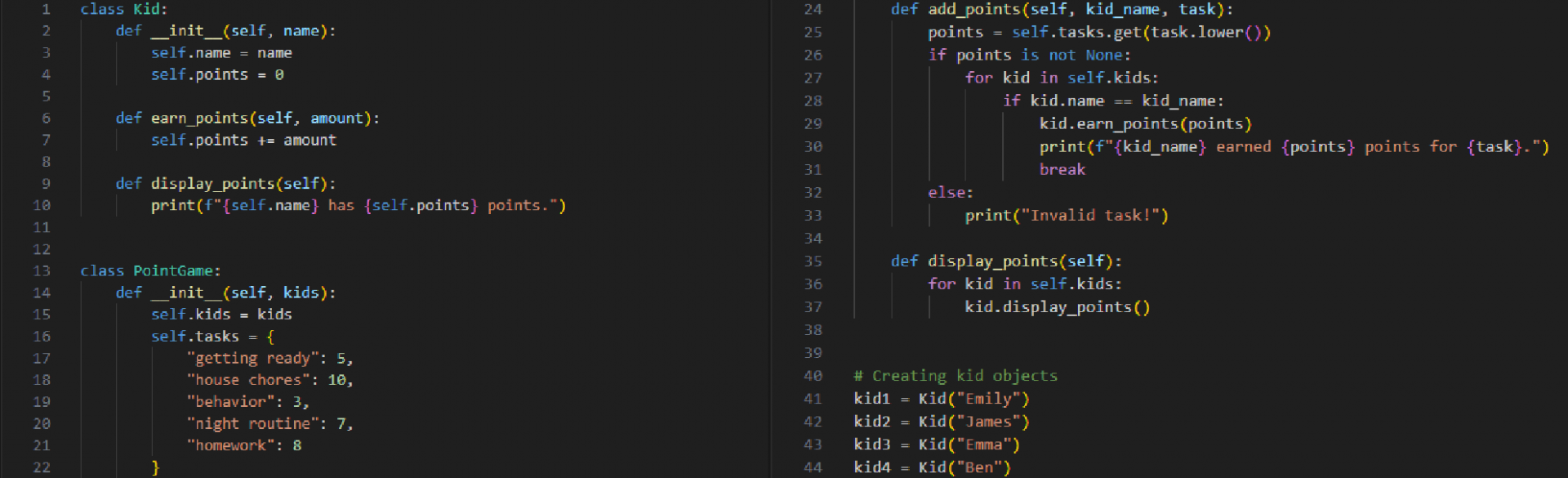
One of Python’s most notable features is its clear, readable syntax. Unlike other programming languages, it strives to be easy to understand even for people who are not programmers. Python’s syntax rules emphasise readability, reducing the cost of maintaining software.
Python uses indentation to delimit blocks of code, for example, rather than braces or specific keywords. This makes code cleaner and easier to follow. It also encourages the use of English words instead of punctuation symbols, so the code reads almost like natural language.
An interpreted language
Python is an interpreted language, which means that code runs line by line rather than being compiled into an executable file before it is run. This makes programs easier to debug because you can test blocks of code in real time. It also makes Python highly portable: wherever you have a Python interpreter, you can run your code.
Dynamic typing
Python is dynamically typed. Put simply, this means that you do not have to specify the type of data a variable will store. Python determines the data type automatically. You can write x = 4, for example, without stating that x is an integer. This differs from statically typed languages such as C++ and Java, where you must specify a variable’s data type when declaring it.
Support for multiple programming paradigms
Python supports several programming paradigms, including object-oriented, imperative and functional programming. That makes it highly versatile. You can select the paradigm best suited to your problem or mix and match paradigms to produce the optimum solution.
A large standard library and third-party package ecosystem
Python comes with ‘batteries included’. In other words, it has a large standard library with modules for a wide range of tasks, from regular expressions to generating XML documents. Python also has an extensive ecosystem of third-party packages available through the Python Package Index (PyPI). Its rich standard library and lively package ecosystem combine to make it a powerful tool for any type of programming project.
Advantages and disadvantages of a continually growing language
Like any tool, Python has strengths and weaknesses. Although it is widely loved for its simplicity and power, not every programming problem fits its profile. Below, we explore some advantages and disadvantages to help you understand when Python may be the right programming language for your project.
Advantages of Python
- Easy to learn: Python was designed with simplicity in mind. Its syntax is clean and easy to understand, which makes it excellent for beginners. If you are learning to program, it is a strong choice.
- Versatility: Python is extraordinarily versatile. You can use it for web development, data science, machine learning, task automation, scripting, GUI application development and much more. If you can imagine it, you can probably build it with Python.
- A large community and strong support: Python has one of the largest and most active communities of any programming language. That makes it easy to find help when you are stuck. There is also a wealth of high-quality learning material and documentation.
- A vast collection of libraries and frameworks: Python comes with an extensive standard library, and many more third-party libraries and frameworks are available. These resources can save a great deal of time and effort by providing ready-made solutions to common problems.
Disadvantages of Python
- Execution speed: Python is interpreted, so it generally runs more slowly than compiled languages such as C++ or Java. If you are developing an application where performance is critical, such as a 3D game or a high-performance data-processing application, it may not be the best option.
- Use on mobile devices: Although mobile applications can be developed with Python, it is not the most popular or best-supported language in this area. Swift for iOS and Java or Kotlin for Android are more common choices for mobile development.
- Concurrency and parallelism: Python supports concurrent and parallel programming, but implementing them correctly can be difficult, especially for beginners. Python’s Global Interpreter Lock (GIL) can also be a performance obstacle in multithreaded situations.
Ideal uses for Python
- Web development: Frameworks such as Django and Flask make Python an excellent choice for web development. Django is particularly useful for large projects because it provides a strong structure and considerable functionality out of the box. Flask is more flexible and lightweight, making it ideal for smaller or more bespoke projects.
- Data science, analytics and machine learning: Python is the leading choice in data science and machine learning. Libraries such as NumPy, pandas and scikit-learn provide powerful tools for data analysis, data manipulation and machine learning. Python also offers Matplotlib and Seaborn for data visualisation.
- Task automation and scripting: Python is excellent for automating small tasks and creating scripts. Whether you need to move files, rename large numbers of files or search for information online, Python can make the work easier.
- Education and programming beginners: Its simple, readable syntax means Python is frequently chosen by beginners and widely used in computer-science education.
Python: an essential tool in the programmer’s toolbox
Having explored Python’s origins, features, advantages and disadvantages, it is clear that the language has an important place in every programmer’s toolbox.
Despite concerns about execution speed and mobile use, Python remains one of the most versatile and accessible programming languages available today. Its readability, extensive community support and ‘batteries included’ standard library make it attractive both to newcomers taking their first steps in programming and to experienced developers looking for an effective and efficient solution.
Python’s use in fields as varied as web development, data science, machine learning and task automation illustrates its adaptability and relevance in today’s digital age.
Ultimately, the choice of programming language will always depend on the particular project, its technical requirements, the project team and each programmer’s skills. For anyone seeking a language that is both powerful and easy to learn, however, Python is hard to beat. With Python in our toolkit, we are well equipped to help bring your projects to life.